
http://Casebased Question in US CMA/Gmsisuccess

Refer first guidlines for students,how to tackle casebased question in US CMA Exam.. click here ✍️
https://globalmgmstudies.blogspot.com/2026/04/how-to-tackle-casebased-question.html
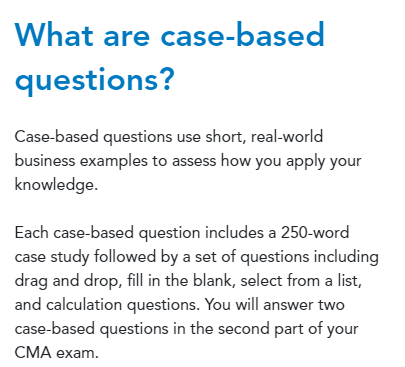
How to tackle Casebased question ⁉️ in US CMA Exam, replacing existing Essay based, compulsory from Sept 2026 exam…
Here’s a normal Essay based question:
Case
XYZ Corp’s actual sales revenue is $500,000, vs. a budget of $600,000. Actual variable costs are $300,000, vs. a budget of $240,000.
Questions
1. Calculate sales variance and variable cost variance.
2. Suggest performance measures for sales and cost management.
Answer
1. *Sales Variance*: ($500,000 – $600,000) = -$100,000 (unfavorable)
*Variable Cost Variance*: ($300,000 – $240,000) = $60,000 (unfavorable)
2. *Performance Measures*:
– Sales: Sales growth %, market share.
– Cost Management: Cost variance %, cost per unit.
Here is US CMA-style case-based questions (CBQs), a realistic ~250-word scenario with 7 integrated tasks mimicking exam formats: fill-in-the-blank, drag-and-drop, hot-spot (select), numerical entry, odd-man-out, MCQ, and assertion-reasoning. These test application of variances and performance metrics, as in Parts 1/2 exams (post-2026 format). No partial credit assumptions—practice timing for 30 min per case.
## Case Scenario
XYZ Corp, a manufacturing firm, budgeted $600,000 sales revenue and $240,000 variable costs for Q1 2026, expecting 10,000 units at $60/unit selling price and $24/unit variable cost. Actual results: sales $500,000 (8,000 units), variable costs $300,000. Fixed costs held steady at $150,000 budgeted/actual. Management notes a competitive market dip but higher input prices. Exhibit: Contribution margin budgeted at 60%; actual operating income $50,000 (vs. budgeted $210,000). CFO tasks you with variance analysis and KPIs for a board report. (148 words)
## CBQ Tasks
**1. Fill-in-the-Blank (Numerical Entry):**
Sales price variance = (Actual price – Budgeted price) × Actual units. Budgeted price $____/unit; actual price $____/unit. Enter both values separated by comma (e.g., 60,62.5).
*(Tests direct computation: Actual price = 500K/8K = $62.50.)*
**2. Drag-and-Drop (Sequence Steps):**
Drag these steps into correct order for flexible budget variance analysis:
A. Compute actual CM/unit
B. Adjust budget to actual activity
C. Identify spending/price variances
D. Calculate volume variance
E. Reconcile total operating income
*Correct order: B, A, C, D, E.*
**3. Odd-Man-Out (Select and Eliminate):**
From this list, select the odd-man-out metric NOT relevant to variable cost control:
– Cost per unit
– Material yield variance
– Sales growth %
– Labor efficiency variance
*Answer: Sales growth % (sales-focused, not cost).*
**4. Hot-Spot (Drag to Target):**
Exhibit (imagine table: Variances column). Drag unfavorable variances to “Performance Issue” hot-spot:
– Sales volume: -$120,000
– Variable spending: +$56,000
– Fixed cost: $0
*(Targets both unfavorable ones.)*
**5. MCQ (Multi-Select):**
Which variances are unfavorable? Select ALL:
A. Sales price (+$20,000)
B. Variable cost total (+$60,000)
C. Contribution margin (-$160,000)
D. Operating income (-$160,000)
*Answers: B, C, D.*
**6. Assertion-Reasoning:**
**Assertion (A):** Variable cost variance is primarily volume-driven.
**Reason (R):** Actual units (8,000) < budgeted (10,000), inflating unit costs.
A. A true, R true; R explains A.
B. A true, R false.
C. A false, R true.
D. Both false.
*Answer: C (A false—it’s spending/price-driven at +$60K despite volume; R true but doesn’t explain).*
**7. Fill-in-the-Blank (KPI Suggestion):**
Recommend TWO sales KPIs and TWO cost KPIs as % metrics for dashboard.
Sales: ____ growth %, ____ share %.
Cost: ____ variance %, ____ per unit.
*(e.g., Sales: -17, Market; Cost: 25, 37.5.)*
Model Answers & Scoring Notes
1. 60,62.5 (2 pts)
2. B-A-C-D-E (3 pts partial)
3. Sales growth % (1 pt)
4. Sales vol + Var spending (2 pts)
5. B,C,D (3 pts)
6. C (1 pt)
7. As per sample (e.g., sales growth/market share; cost var/cost per unit) (4 pts)
Total: ~16 pts. Focus: Link variances to decisions; practice reveals interconnections.