
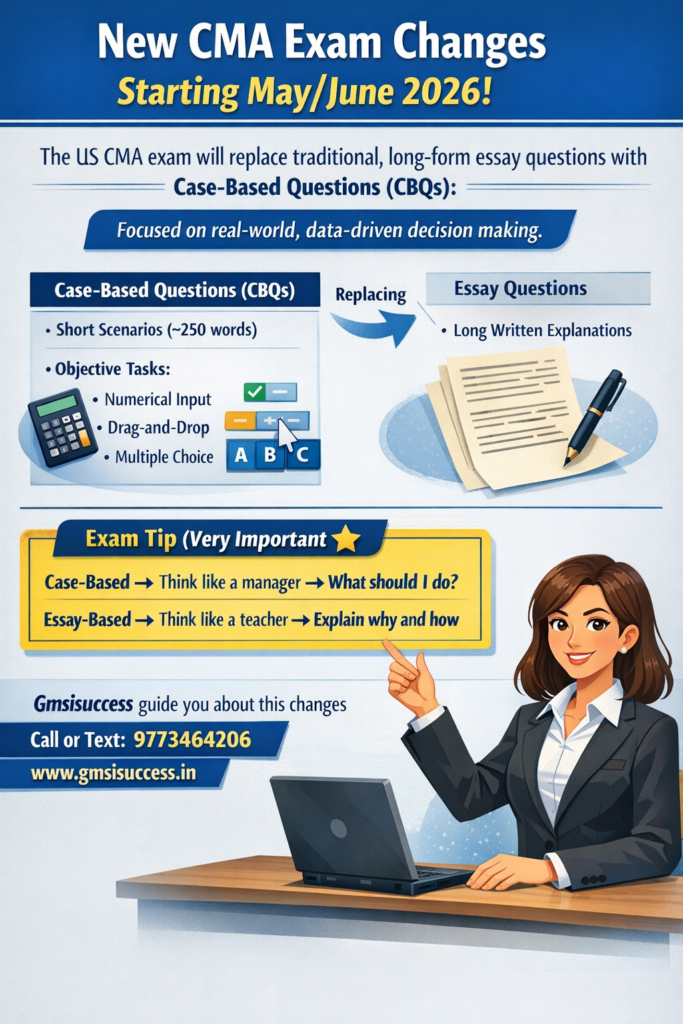

- Here is a 100-Question Mixed Assessment Test to evaluate basic business, accounting, analytics and management concepts.
It includes MCQ, Fill in the Blanks, True/False, Match the Following, and Odd Man Out.
Comprehensive Business & Accounting Aptitude Test
(100 Mixed Concept Questions)
Section A: Multiple Choice Questions (1–40)
1. Financial Accounting primarily focuses on:
A. Internal decision making
B. External reporting
C. Production planning
D. Cost control
Answer: B
2. Which accounting principle requires revenue to be recorded when earned?
A. Matching principle
B. Accrual principle
C. Consistency principle
D. Conservatism
Answer: B
3. Contribution margin equals:
A. Sales – Fixed Cost
B. Sales – Variable Cost
C. Sales – Total Cost
D. Profit – Fixed Cost
Answer: B
4. Opportunity cost means:
A. Explicit cost
B. Cost of next best alternative
C. Production cost
D. Historical cost
Answer: B
5. Corporate governance primarily protects:
A. Employees
B. Customers
C. Shareholders’ interests
D. Suppliers
Answer: C
6. Which is NOT part of internal control?
A. Control environment
B. Risk assessment
C. Sales forecasting
D. Monitoring
Answer: C
7. Break-even point occurs when:
A. Profit is maximum
B. Total revenue = Total cost
C. Contribution = Fixed cost + Profit
D. Marginal cost = Revenue
Answer: B
8. SWOT analysis evaluates:
A. Market share
B. Internal and external environment
C. Only external threats
D. Only internal strengths
Answer: B
9. Which chart is best for showing trend over time?
A. Pie chart
B. Line graph
C. Histogram
D. Scatter plot
Answer: B
10. Regression analysis is used to:
A. Forecast relationships
B. Measure liquidity
C. Calculate cost
D. Audit systems
Answer: A
11. Standard costing is mainly used for:
A. Tax calculation
B. Cost control
C. Cash management
D. Financial reporting
Answer: B
12. Data warehouse stores:
A. Operational real-time data
B. Historical analytical data
C. Temporary data
D. Accounting entries only
Answer: B
13. Which is a non-financial performance measure?
A. ROI
B. Net Profit
C. Customer satisfaction
D. Gross margin
Answer: C
14. Internal audit primarily evaluates:
A. Financial statements only
B. Internal controls and risk management
C. Tax compliance
D. Production efficiency
Answer: B
15. Correlation coefficient ranges between:
A. 0 to 1
B. –1 to +1
C. –10 to +10
D. 0 to 100
Answer: B
16. Which cost changes with production level?
A. Fixed cost
B. Variable cost
C. Sunk cost
D. Opportunity cost
Answer: B
17. Ethical behavior in business means:
A. Profit maximization only
B. Following laws and moral standards
C. Avoiding competition
D. Maximizing production
Answer: B
18. Balanced Scorecard includes:
A. Financial perspective
B. Customer perspective
C. Internal process perspective
D. All of the above
Answer: D
19. Big Data is characterized by:
A. Volume
B. Variety
C. Velocity
D. All of the above
Answer: D
20. Expected value is calculated as:
A. Probability × Outcome
B. Sum of (Probability × Payoff)
C. Average profit
D. Median value
Answer: B
21. Responsibility accounting assigns accountability to:
A. Departments
B. Managers
C. Investors
D. Auditors
Answer: B
22. Scatter diagram shows:
A. Frequency distribution
B. Relationship between variables
C. Cost allocation
D. Budget variance
Answer: B
23. Value chain analysis was introduced by:
A. Michael Porter
B. Adam Smith
C. Peter Drucker
D. Henry Fayol
Answer: A
24. Variance analysis compares:
A. Actual vs Standard
B. Profit vs Sales
C. Revenue vs Assets
D. Cash vs Inventory
Answer: A
25. A risk register records:
A. Financial transactions
B. Identified risks and mitigation plans
C. Employee records
D. Audit opinions
Answer: B
26. Which department manages liquidity?
A. HR
B. Treasury
C. Production
D. Marketing
Answer: B
27. Time series analysis studies:
A. Cross sectional data
B. Data over time
C. Random data
D. Survey data
Answer: B
28. Cost driver is:
A. Factor causing cost change
B. Budget limit
C. Cost allocation rule
D. Revenue factor
Answer: A
29. Activity Based Costing allocates overhead based on:
A. Labor hours
B. Machine hours
C. Activities
D. Sales value
Answer: C
30. Histogram is used to display:
A. Categorical data
B. Continuous frequency distribution
C. Trend analysis
D. Correlation
Answer: B
31. Data integrity means:
A. Data security
B. Accuracy and consistency of data
C. Data storage
D. Data mining
Answer: B
32. Internal control segregation of duties prevents:
A. Errors and fraud
B. Sales loss
C. Inventory shortage
D. Budget variance
Answer: A
33. Strategic management focuses on:
A. Short term profit
B. Long term competitive advantage
C. Accounting records
D. Employee attendance
Answer: B
34. KPI stands for:
A. Key Performance Indicator
B. Key Profit Index
C. Knowledge Planning Indicator
D. Key Product Inventory
Answer: A
35. Regression equation is:
A. Y = a + bX
B. X = a + bY
C. Y = abX
D. Y = X²
Answer: A
36. Lean management focuses on:
A. Increasing inventory
B. Eliminating waste
C. Increasing overhead
D. Increasing bureaucracy
Answer: B
37. Enterprise Risk Management integrates:
A. Financial risks only
B. Operational risks only
C. All organizational risks
D. Market risks only
Answer: C
38. Ethics hotline is used for:
A. Marketing
B. Reporting misconduct
C. HR recruitment
D. Budget approval
Answer: B
39. Benchmarking means:
A. Cost reduction
B. Comparing with best practices
C. Audit testing
D. Risk assessment
Answer: B
40. Dashboards in analytics show:
A. Accounting entries
B. Visual performance metrics
C. Audit opinions
D. Tax records
Answer: B
Section B: Fill in the Blanks (41–55)
41. Assets = Liabilities + ______
Answer: Equity
42. Fixed costs remain ______ within relevant range.
Answer: Constant
43. The probability weighted average outcome is called ______.
Answer: Expected value
44. Correlation measures the ______ between two variables.
Answer: Relationship
45. Ethical principles include integrity, objectivity and ______.
Answer: Confidentiality
46. ERP stands for ______.
Answer: Enterprise Resource Planning
47. Budget variance = Actual – ______.
Answer: Budget
48. A system of policies ensuring reliable reporting is called ______.
Answer: Internal control
49. In regression, dependent variable is usually represented by ______.
Answer: Y
50. Time series trend shows ______ direction over time.
Answer: Long term
51. Governance ensures accountability to ______.
Answer: Stakeholders
52. ABC stands for ______.
Answer: Activity Based Costing
53. ROI means ______.
Answer: Return on Investment
54. Risk probability × impact = ______.
Answer: Risk exposure
55. Break-even occurs when profit equals ______.
Answer: Zero
Section C: True or False (56–70)
56. Financial accounting is mainly for external users.
True
57. Variable cost per unit changes with production.
False
58. Internal audit is independent from management operations.
True
59. Pie charts show proportions.
True
60. Negative correlation means variables move in opposite directions.
True
61. Risk assessment identifies potential threats.
True
62. Strategic management focuses only on short term decisions.
False
63. Data analytics supports decision making.
True
64. Standard costing helps cost control.
True
65. Opportunity cost appears in accounting records.
False
66. Scatter plots help visualize correlation.
True
67. Corporate governance improves transparency.
True
68. Fixed costs change proportionally with output.
False
69. Big data includes structured and unstructured data.
True
70. Balanced scorecard only measures financial results.
False
Section D: Match the Following (71–85)
Column A Column B
71. Break-even A. Revenue = Cost
72. Correlation B. Relationship measure
73. Histogram C. Frequency distribution
74. SWOT D. Strategic analysis
75. KPI E. Performance indicator
Answers:
71-A
72-B
73-C
74-D
75-E
Column A Column B
76. Internal Control A. Risk mitigation
77. Regression B. Forecasting model
78. Balanced Scorecard C. Performance framework
79. Data Warehouse D. Historical analytics
80. ABC costing E. Activity based allocation
Answers:
76-A
77-B
78-C
79-D
80-E
Column A Column B
81. Line chart A. Trend
82. Pie chart B. Proportion
83. Scatter plot C. Correlation
84. Bar chart D. Comparison
85. Dashboard E. KPI visualization
Answers:
81-A
82-B
83-C
84-D
85-E
Section E: Odd Man Out (86–100)
86. Balance Sheet / Income Statement / Cash Flow Statement / Marketing Report
Odd: Marketing Report
87. Fixed Cost / Variable Cost / Sunk Cost / Sales Revenue
Odd: Sales Revenue
88. Scatter Plot / Histogram / Pie Chart / Journal Entry
Odd: Journal Entry
89. Correlation / Regression / Probability / Depreciation
Odd: Depreciation
90. Integrity / Objectivity / Confidentiality / Inventory
Odd: Inventory
91. Governance / Risk Management / Internal Control / Production Scheduling
Odd: Production Scheduling
92. Mean / Median / Mode / Inventory Turnover
Odd: Inventory Turnover
93. SWOT / PESTLE / Value Chain / Ledger
Odd: Ledger
94. Budgeting / Forecasting / Variance Analysis / Payroll Processing
Odd: Payroll Processing
95. Bar Chart / Line Graph / Scatter Plot / Accounts Payable
Odd: Accounts Payable
96. Big Data / Data Warehouse / Data Analytics / Trial Balance
Odd: Trial Balance
97. Lean Management / Kaizen / Six Sigma / Sales Invoice
Odd: Sales Invoice
98. ROI / ROE / Profit Margin / Warehouse Inventory
Odd: Warehouse Inventory
99. Strategic Planning / Mission / Vision / Petty Cash Voucher
Odd: Petty Cash Voucher
100. Probability / Expected Value / Regression / Purchase Order
Odd: Purchase Order
Thanks students for your efforts 📊📘